Chinese Numerology vs Western Numerology: Key Differences Explained
Chinese numerology vs Western numerology are two separate systems that assign meaning to numbers, but they work in very different ways. Chinese numerology is rooted in sound, symbolism, and cultural belief especially the idea that numbers that sound like lucky or unlucky words bring good or bad fortune. Western numerology, by contrast, uses mathematical calculations based on your name and birth date to map out personality traits and life patterns. Neither system is scientifically proven, but both have millions of followers worldwide and serve different cultural and personal purposes.
Key Takeaways
- Chinese numerology focuses on how numbers sound in Chinese dialects, making 8 lucky (sounds like “prosperity”) and 4 unlucky (sounds like “death”)
- Western numerology, especially the Pythagorean system, assigns numbers to letters of the alphabet and uses birth dates to calculate life path numbers
- Chinese numerology is deeply tied to Feng Shui, business decisions, and cultural superstitions across East Asia
- Western numerology is more focused on self-discovery, personality analysis, and life forecasting
- Both systems treat numbers as meaningful beyond their mathematical value, but the logic behind each system is completely different
- The number 8 is the luckiest number in Chinese numerology; in Western numerology, 8 represents ambition and material success an interesting overlap
- Chinese numerology is culturally specific; Western numerology claims to be universally applicable across languages and cultures
- In 2026, both systems remain popular in personal development, business naming, and spiritual communities globally
What Is Chinese Numerology and How Does It Work?
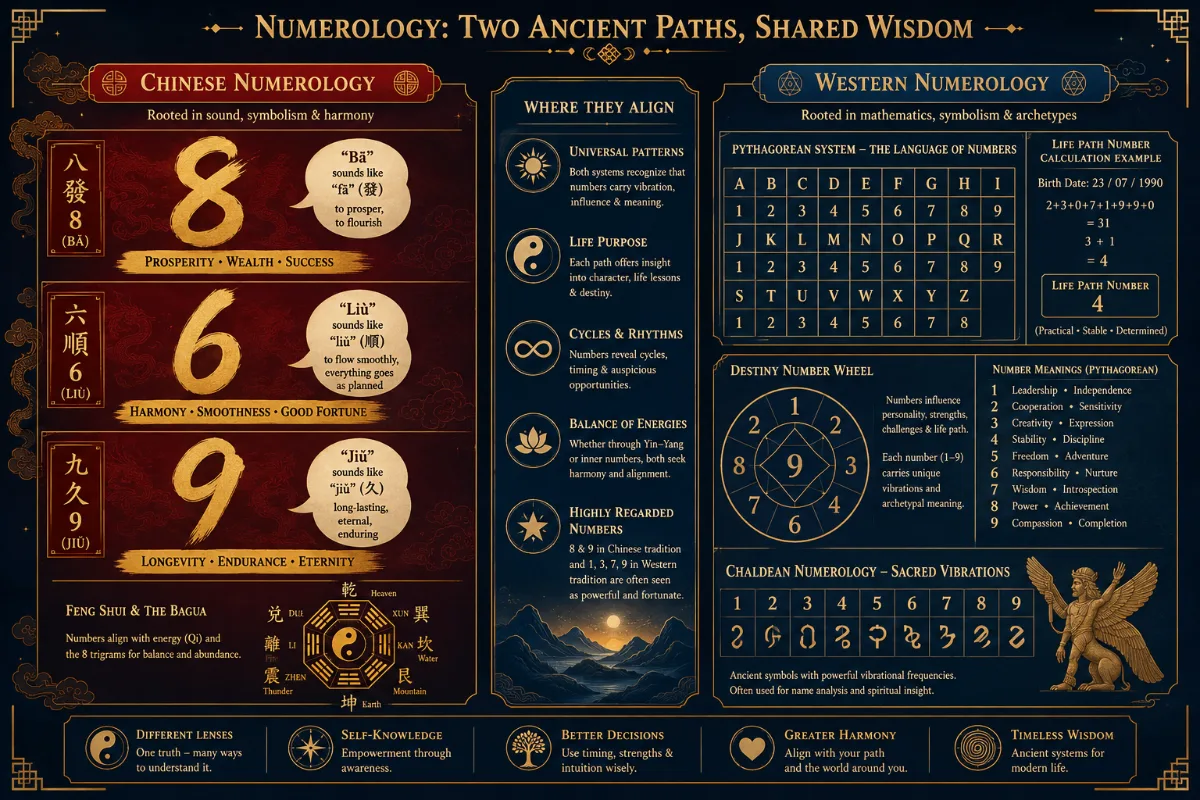
Chinese numerology assigns good or bad meaning to numbers based on how they sound in Mandarin, Cantonese, and other Chinese dialects. A number is considered lucky if it sounds like a positive word, and unlucky if it sounds like something negative.
Here is a straightforward breakdown of the most common number meanings in Chinese numerology:
| Number | Pronunciation (Mandarin) | Meaning |
|---|---|---|
| 1 | Yi | Beginning, loneliness |
| 2 | Er | Balance, harmony (good for pairs) |
| 3 | San | Growth, but also sounds like “separation” in some dialects |
| 4 | Si | Sounds like “death” — strongly avoided |
| 6 | Liu | Sounds like “flow” or smooth progress — very lucky |
| 8 | Ba | Sounds like “prosper” or “wealth” — extremely lucky |
| 9 | Jiu | Sounds like “long-lasting” — associated with longevity |
Real-world example: The 2008 Beijing Olympics opening ceremony began on 08/08/2008 at 8:08 PM — a deliberate choice to maximize the luck associated with the number 8.
Common mistake: Many people assume Chinese numerology is one unified system. In fact, meanings can shift between Mandarin and Cantonese dialects. The number 3, for instance, is more negative in Cantonese than in Mandarin.
Chinese numerology also connects to Feng Shui, where the placement of numbers in a home or business address is believed to affect energy flow and fortune.
What Is Western Numerology and How Does It Work?
Western numerology is a system that uses your full birth name and birth date to calculate specific numbers, which are then interpreted to reveal personality traits, life challenges, and future patterns.
The most widely used Western system is the Pythagorean system, named after the ancient Greek philosopher Pythagoras, who believed numbers were the foundation of all reality.
How the Pythagorean system works:
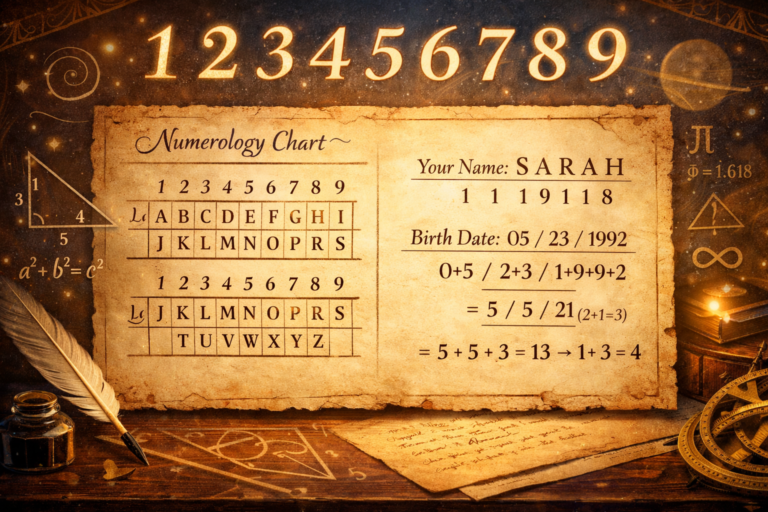
- Each letter of the alphabet is assigned a number from 1 to 9 (A=1, B=2, C=3… I=9, J=1, and so on)
- You add up the numbers in your full birth name to get your “Expression Number” or “Destiny Number”
- You add up the digits of your birth date (month + day + year) to find your “Life Path Number”
- You reduce any two-digit result to a single digit by adding the digits together (except for master numbers 11, 22, and 33)
Example: Someone born on July 14, 1990 calculates their Life Path Number as: 7 + 1 + 4 + 1 + 9 + 9 + 0 = 31, then 3 + 1 = 4. A Life Path 4 in Western numerology represents hard work, structure, and reliability.
There is also the Chaldean system, an older method from ancient Babylon that assigns numbers differently and considers compound numbers more carefully. It is less common but still used by some practitioners.
Chinese Numerology vs. Western Numerology: Core Differences
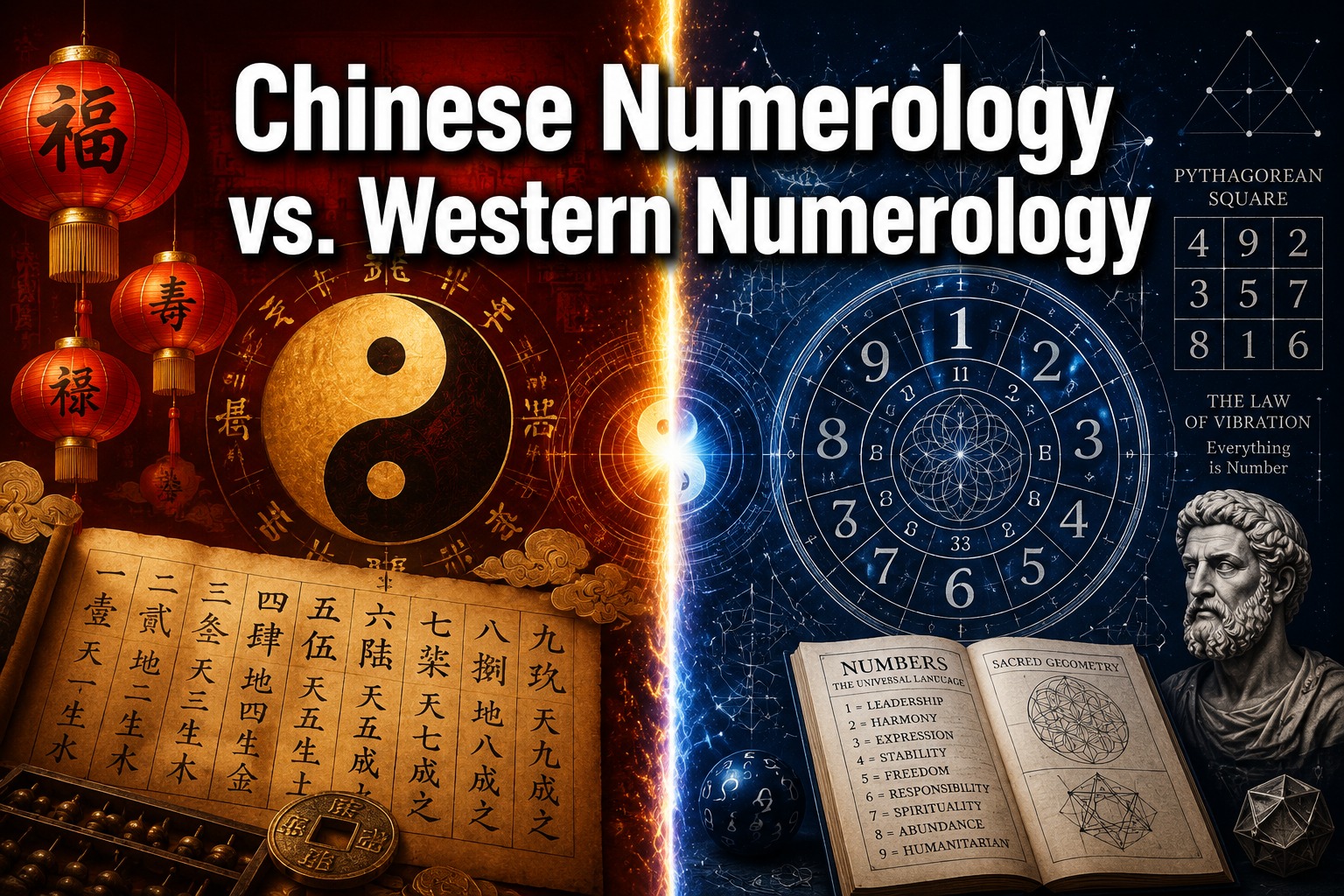
The biggest difference between Chinese numerology and Western numerology is what the systems are actually based on.
| Feature | Chinese Numerology | Western Numerology |
|---|---|---|
| Core basis | Sound of numbers in Chinese dialects | Math calculations from name and birth date |
| Primary use | Luck, business decisions, Feng Shui | Personality analysis, life path guidance |
| Cultural scope | Specific to Chinese and East Asian cultures | Claims universal application |
| Lucky numbers | 6, 8, 9 | Varies by Life Path; no universal lucky number |
| Unlucky numbers | 4 (and sometimes 3, 5) | None universally; depends on context |
| Key figures | Rooted in ancient Chinese philosophy and I Ching | Attributed to Pythagoras and ancient Babylon |
| Personal calculation | Based on cultural context, not personal birth data | Highly personalized using name and birth date |
Choose Chinese numerology if you are making decisions tied to East Asian cultural contexts — like naming a business for a Chinese market, choosing a phone number, or working with Feng Shui principles.
Choose Western numerology if you are interested in self-discovery, personality profiling, or understanding recurring patterns in your personal life.
How Do Lucky and Unlucky Numbers Compare Between the Two Systems?
In Chinese numerology, luck is tied directly to sound. In Western numerology, no number is universally lucky or unlucky context and the individual’s full numerology chart matter more.
Chinese lucky numbers: 6, 8, 9
Chinese unlucky numbers: 4, and in some dialects, 5 and 7
Western numerology perspective on those same numbers:
- 4 in Western numerology means hard work and stability — not bad at all
- 8 in Western numerology represents ambition, authority, and financial success — aligning somewhat with the Chinese view
- 9 in Western numerology represents completion, wisdom, and humanitarianism
Key insight: The number 8 is one area where Chinese and Western numerology actually agree on a positive meaning, though for completely different reasons. Chinese numerology says 8 sounds like wealth. Western numerology says 8 vibrates with material power and leadership.
Which System Is More Widely Used in 2026?
Both systems are actively used, but in different parts of the world and for different reasons.
Chinese numerology remains deeply embedded in everyday life across China, Hong Kong, Taiwan, Singapore, and Chinese diaspora communities worldwide. It influences real estate pricing (homes with the number 8 in the address sell for premiums), phone number selection, business naming, and wedding dates.
Western numerology has a strong following in North America, Europe, and Australia, primarily in spiritual and self-help communities. It appears frequently in personal development books, astrology-adjacent content, and wellness coaching.
In 2026, both systems have found new audiences through social media and digital content, with numerology-related searches growing steadily on platforms like YouTube and TikTok.
What Are the Biggest Criticisms of Each System?
Neither system has scientific support, and that is the most consistent criticism both face.
Criticisms of Chinese numerology:
- It is dialect-dependent, meaning the same number can mean different things in different Chinese languages
- It is not applicable outside of Chinese linguistic contexts without losing its core logic
- Superstitions around numbers like 4 have real economic costs (buildings skip the 4th floor, prices avoid 4s)
Criticisms of Western numerology:
- Reducing a person’s entire life to a single digit oversimplifies human complexity
- Different practitioners using the same birth data can reach different conclusions
- The Pythagorean and Chaldean systems sometimes contradict each other
Bottom line: Both systems are belief frameworks, not predictive sciences. They are most useful as tools for reflection, cultural understanding, or personal meaning-making not as decision-making authorities.
FAQ
What is the main difference between Chinese and Western numerology?
Chinese numerology is based on how numbers sound in Chinese dialects and is tied to luck and cultural beliefs. Western numerology uses math calculations from your name and birth date to analyze personality and life patterns.
Is the number 4 bad in Western numerology?
No. In Western numerology, 4 represents stability, hard work, and discipline. The unlucky association with 4 is specific to Chinese numerology, where it sounds like the word for “death” in Mandarin.
Why is 8 lucky in both Chinese and Western numerology?
In Chinese numerology, 8 sounds like the word for “prosperity.” In Western numerology, 8 represents ambition and material success. The positive meaning overlaps, but the reasoning is completely different.
Can you use both systems together?
Yes, some people consult both systems for different purposes — Chinese numerology for business or cultural decisions, and Western numerology for personal growth and self-reflection.
What is a Life Path Number in Western numerology?
A Life Path Number is calculated by adding all the digits in your birth date until you reach a single digit (or master number 11, 22, or 33). It is considered the most important number in Western numerology.
Is Chinese numerology the same as Feng Shui?
They are related but not the same. Feng Shui is a broader system about energy flow in physical spaces. Chinese numerology is one component of Feng Shui, particularly when it comes to choosing addresses, dates, and names.
Which numerology system is older?
Both have ancient roots. Chinese numerology connects to the I Ching, which dates back over 3,000 years. Western numerology is often traced to Pythagoras (around 570-495 BCE), though Chaldean numerology from ancient Babylon may be even older.
Does Western numerology work for non-English names?
The Pythagorean system was designed for the Latin alphabet. Practitioners adapt it for other languages, but the system was not originally built for non-Latin scripts, which is a limitation.
Try these free numerology tools:
- Name numerology calculator: find your name number in Chaldean and Pythagorean
- Life Path Number calculator: your number from your date of birth
- Life Path Numbers guide: meaning, love and career for every number
Is your name right for your date of birth?
Get your personal Name Correction & Numerology Report: your Life Path, a name check against your birth date with lucky spelling suggestions, your Lo Shu Grid, lucky numbers and colours, and a 12-month forecast with your best days. 12-page PDF, instant download.
Get my reportConclusion
Chinese numerology and Western numerology are genuinely different systems with different logic, different cultural roots, and different applications. Chinese numerology is sound-based, culturally specific, and focused on luck and fortune. Western numerology is calculation-based, claims broader applicability, and focuses on personality and life path analysis.
Actionable next steps:
- If you are working in or marketing to East Asian markets, learn which numbers are lucky or unlucky in Chinese numerology — it directly affects business decisions and consumer behavior
- If you are interested in personal development or self-reflection, calculate your Western numerology Life Path Number using your birth date and explore what it says about your tendencies
- If you are naming a business or product for a global audience, consider running both systems as a quick cultural and personal check
- Treat both systems as frameworks for reflection, not as fixed rules — the real value is in the questions they prompt, not the answers they claim to guarantee
References
- Schimmel, A. (1993). The Mystery of Numbers. Oxford University Press.
- Skinner, S. (2009). Sacred Geometry: Deciphering the Code. Sterling Publishing.
- Smith, R. J. (2012). Fortune-Tellers and Philosophers: Divination in Traditional Chinese Society. Westview Press.
- Yang, C. K. (1961). Religion in Chinese Society. University of California Press.